A History
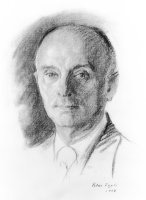
Sewell C. Biggs
Opening its doors in 1993, The Biggs Museum of American Art quickly became one of the most important museums in Delaware. The Museum was founded to display the art collection of its founder, Sewell C. Biggs, and to delight and educate its visitors on the valuable cultural legacy of the region. The Museum displays the finest Delaware-made furniture and silver collection as well as the only painting and sculpture collection in the region able to tell the story of American representational art. The Museum’s eighteen galleries are arranged to emphasize the evolution of Mid-Atlantic fashion in the fine and decorative arts from the early 1700s to the present and to present several focus exhibitions annually. Art education is at the core of the Biggs Museum’s mission and opportunities to experience the Museum in different ways are offered throughout the year.
The Biggs Museum of American Art is located at 406 Federal Street in downtown Dover, Delaware. Early supporters of the Biggs Museum, Delaware’s former first lady Elise DuPont and Senator Nancy Cook, helped carve a gracious niche within State government to hold this unique, private museum.
Since the 2003 death of its founder, the Biggs Museum continues to expand and refine its permanent collection along the path carved by Sewell C. Biggs. His interest in displaying the symbols of regional, artful spaces alongside his fine-art teaching collection is maintained in every new accession. Sewell’s life-long passions of collecting, architecture, American and regional arts, and modern-art patronage are combined and presented in the Biggs Museum. The result is a museum founded to define the artistic life of the entire State of Delaware.
Sewell C. Biggs Childhood and Early Collecting
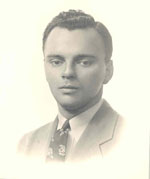
Sewell C. Biggs
Born on November 12, 1914 in Middletown, DE to J. Frank and Emma L. Biggs, Sewell’s family was economically and geographically tied to Delaware and the Mid-Atlantic Region through an illustrious history of lawyers, bankers, farmers and politicians. Among the 100s of art objects and archival materials Sewell left to the Biggs Museum, among his earliest personal items was a bag of marbles It was often discussed that Sewell opened his first museum in his childhood bedroom where he charged visitors a nickel to see his collection of marbles, seashells, Confederate money, WW I artifacts, and illustrations from
American Boy magazine by Wilmington illustrator Frank Schoonover.
Among the earliest antiques Sewell collected were this Philadelphia looking glass (1815-30) that hung in the main parlor of his childhood home and descended from his father’s family. He also inherited a mahogany veneered butler’s desk and a set of three portraits by James Van Dyck (all ca. 1825) of his mother’s New Jersey ancestors, the Beekmans.
During his teenage years, Sewell often accompanied his mother and family friend, Mary C.W. Lewis, on antique-buying road trips through the Pennsylvania and Delaware landscape.
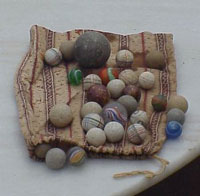
Sewell C. Biggs' marble collection
Sewell Biggs expanded his horizons with education, travel and real estate. After following in the family footsteps and passing the Virginia Bar exam, Sewell immersed himself in the study of architecture at Oxford and Cambridge Universities. He and his friend, Charles DuPont, spent 1937 traveling around the globe photographing the major architectural structures of many of the world’s continents. Sewell’s own photograph albums attest to his respect for the genius of each culture’s architectural heritage while also embracing the new visual vocabulary of Modern building.
At the end of the War, modern architecture was heavily embraced by the new world power of America and architects like Mies Van de Rhoe, Walter Gropius, Frank Lloyd Wright, and Le Corbusier were spreading an electric influence. Apparently, Sewell was so taken with the new architecture that in 1958 he built an International Style vacation house in DelRay Beach, FL designed by recent Yale graduate, Paul Rudolf. It may seem surprising that a man with a distinct respect for early America would also love American modernism, decorating his new house with a conspicuous lack of antiques and selecting furniture by renowned designers like Hans Wagner, but again Sewell’s interests laid not with any particular period or medium but with the finest objects found in specific localities. As another example, when Sewell bought an apartment in Manhattan, the interior was decorated with New York and Philadelphia federal-period furniture with French –influenced moldings and light fixtures.
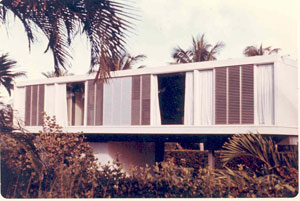
DelRay Beach, FL house
At this same time, Sewell began buying and refurbishing 18th-century farmhouses throughout New Castle and Kent Counties here in Delaware. These historic settings became the first personal displays of his growing collection of Americana and, perhaps, set an influential boundary to his collecting of art forms of a particularly domestic nature. Even today, visitors of the Biggs Museum remark on the domestic mood of the gallery spaces and the collections. Sewell never collected objects from civic or professional architectural settings-he always collected to decorate his own homes and the museum continues to reflect this interest.
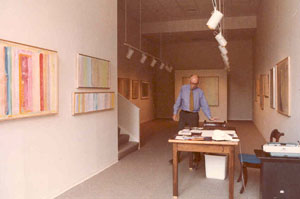
Grand Gallery
While Sewell was exploring, and collecting much of, 18th- and 19th-century Delaware and Philadelphia, he began a long series of relationships with area non profits serving on the Boards of the Grand Opera House, the Delaware State Arts Council, the Delaware Art Museum, the Historical Society of Delaware, the John Dickinson Society and chaired a committee for a major restoration of the 1768 Old St. Anne’s Church of Middletown. He was a member of Winterthur, Yale University Art Galleries, the Metropolitan Museum, and the Art Institute of Chicago. At the same time, he began progressive support of Delaware Valley education with large levels of funding to area schools including the University of Delaware, endowing an Americanist position in the Art History Department, as well as the formation of the Choptank Foundation Scholarship Program hosting Scandinavian students for a year of study at U of D. Sewell opened the Grand Gallery at the Wilmington Opera House holding monthly exhibitions of area artists. Several of the works from these exhibitions made their way to the Biggs Museum permanent collections, and its offices, and displays Sewell’s patronage of the local art scene and a desire to see local artists succeed.
The Biggs Museum of American Art
Sewell Biggs’s artistic interests are culminated in the display of his collection in the museum’s galleries. Using the Metropolitan Museum as inspiration, Sewell sought to create a series of galleries, organized on a timeline, that balanced painting, sculpture, architectural elements, furniture, silver and metals, ceramics, and textiles to highlight the important formal qualities the arts shared in the Mid-Atlantic since 18th century.
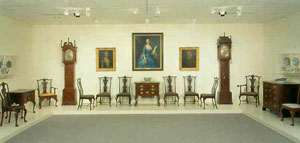
The Biggs Museum of American Art Gallery
The Biggs Museum grows to accommodate new accessions, gifts and purchases, that fill holes in the educational display of the collections. Within the first few years of opening, Sewell added the earliest documented chairs by a Delaware maker, unique examples of Delaware tall-case clocks by some of the finest craftsmen of Early America and examples of Mid-Atlantic 19th-century furniture. The Biggs Museum’s painting collection was the fastest-growing component of the museum with important additions of early-Delaware portraits, 19th- and 20th-century American Impressionism, works by artists of the Hudson River School of American Landscape Painting, early works by instructors and graduates of the Pennsylvania Academy, Brandywine River School Illustrators, fine examples of 20th-century Delaware Modernism, living regional artists, and little-known vernacular artists of Delaware’s past.
By 1998, the Biggs Museum launched a temporary exhibitions program of lending and borrowing works for special concentration shows based on areas of the permanent collection. Today, the Museum creates landmark exhibitions on diverse topics of Delaware’s art scene. Highlights include exhibitions on Thomas Cole, Delaware needlework samplers, Frank Schoonover, the Janvier Family of cabinetmakers, John Hesselius, early Delaware chairs and blanket chests, Edward Redfield, early Delaware clocks and silver, and contemporary artists and artisans from the region. Alongside these exhibitions, the Biggs Museum began publishing important catalogues including its own two-volume collection catalogue,
Almost Forgotten: Delaware Women Artists and Art Patrons 1900-1950, Delaware Clocks, Delaware Silver: the Col. Kenneth P. and Regina I. Brown Collection, Greetings from Delaware: The Jann Haynes Gilmore and B. Joyce Puckett Collection of Artist Greeting Cards and many more to come.


